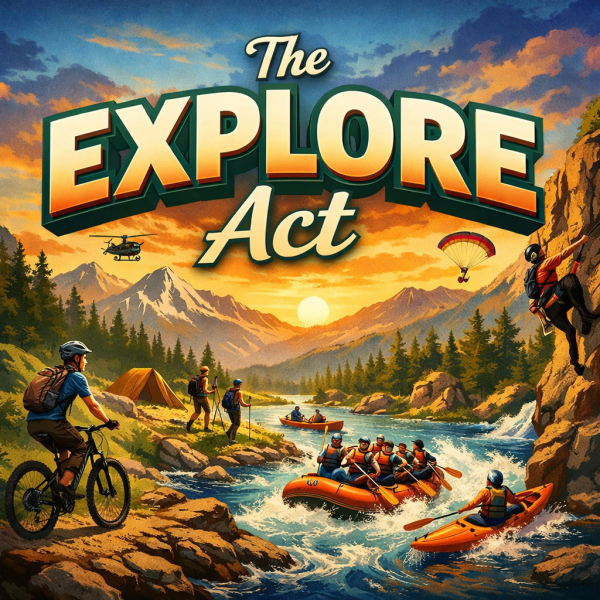
On January 4, 2025, in one of his last presidential acts, President Biden signed new legislation into law titled Expanding Public Lands Outdoor Recreation Experiences Act, commonly known as the EXPLORE Act. This act combined a variety of recreation-related initiatives into one broad recreation bill, resulting in the EXPLORE Act. This law passed both the House and the Senate unanimously.
The EXPLORE Act authorizes a variety of recreational initiatives on federal lands, including Forest Service, BLM, National Park Service, and all other federal lands. The law funds building long distance bike trails and rock-climbing areas, streamlines permitting processes for guiding companies, improves accessible infrastructure for recreational, streamlines filming permits, and expands parking and broadband access on federal lands. The Act also specifically references the economic importance of outdoor recreation, citing the $1.2 trillion economic impact outdoor recreation has on rural economies.
The EXPLORE Act requires federal public land managers to modernize administrative processes and expand opportunities for outdoor recreation. Notably, the Act specifically authorizes concessionaires, guides, and other recreational providers operating pursuant to special use permits on federal lands to have customers execute liability releases (also referred to as “exculpatory agreements” in the legislation, which are the same legal concept as liability releases or waivers).
Section 319 of the EXPLORE Act states:
“A federal land management agency shall not implement or enforce any regulation or policy prohibiting the use of an exculpatory agreement between a recreation service provider or a holder of a commercial use permit and a customer relating to services provided under a special recreation permit or a commercial use authorization.”
This new federal law now allows recreational providers to have customers execute liability releases for any recreational activity on federal land. This provision in the EXPLORE Act allowing releases extends to a wide variety of recreational activities, including snowmobile tours, dog sled tours, rafting guides, skiing, mountain biking, backcountry hut trips, heli-skiing guiding, outfitting guides, equestrian activities, rock climbing, camping, Nordic skiing, special events and competitions, and any other recreational activity on federal lands. The law covers recreational activities in both summer and winter. As is the law in all states, the use of liability releases under the EXPLORE Act only applies to claims of “ordinary negligence”—liability releases cannot be used to waive claims of gross negligence in any state or under federal law.
This bi-partisan, bicameral federal legislation is especially critical for on-going legislative efforts on liability releases at the state level, where Oregon’s 2014 case law contradicts the new federal policy. In Oregon, the Protect Oregon Recreation coalition (POR) is hopeful that this new federal law will help translate into enforceable releases in Oregon. The POR coalition includes a wide range of recreational users, providers, conservation groups, and nonprofits. Members of the POR coalition span skiing, mountain biking, rafting and outfitter guides, equestrian, boating, fitness gyms, and organizations such as riverkeepers, trails coalitions, and other non-profits. Together, we are advocating for 2026 legislation—S.B. 1593 and H.B. 4071—that would allow recreational providers to obtain enforceable liability releases, in alignment with the federal EXPLORE act.
Oregon is the only Western state that does not allow the use of liability releases, and this has resulted in an insurance crisis in the state. While recreational providers operating on federal public lands in other states are implementing this new legislation under the EXPLORE Act, Oregon recreational providers are unable to fully implement this federal legislation unless the Oregon legislature takes action. As a result, Oregon recreational providers—many who are family-owned businesses located in rural areas—are at a steep competitive disadvantage compared to other recreational providers in other Western states.
The inability of recreational providers to obtain enforceable liability releases in Oregon will continue to make liability insurance much more expensive in Oregon compared to all other western states. As a result, these significantly increased insurance expenses means that these costs are passed on to the customer, making access to affordable recreation increasingly expensive in Oregon without legislative reform. In turn, the inability to enforce liability releases reinforces Oregon’s long-standing reputation as having an unfavorable business climate in the state that prevents growth and investment across the state, especially in rural communities.