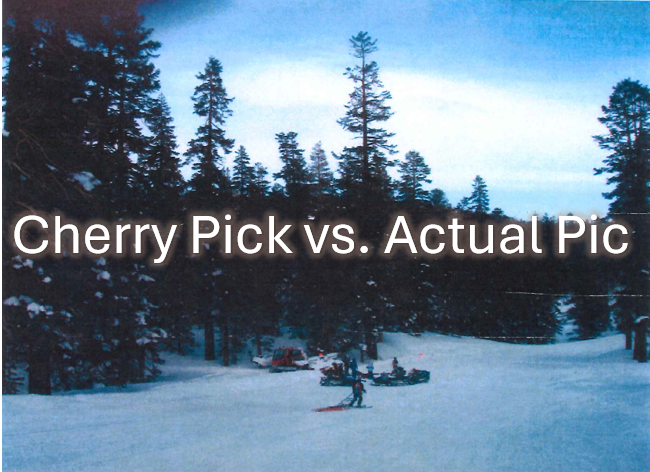
On the day that SB1517A narrowly passed the floor of the Oregon Senate, despite having received overwhelming public opposition, Senator Prozanski provided an example of a tragic accident in California where a snowboarder travelled into a snow grooming machine. His example leaves out the full context of that unfortunate situation.
In Today’s article in the Oregonian, Sen. Prozanski again fails to mention essential context as he raises this distraction from his own efforts over the last decade to deny holistic public discussion on the issue of waiver reform. His comments state that California’s waiver law left a snowboarder “out of luck”. As if the California courts only spent two seconds evaluating the situation and simply dismissed it because the snowboarder signed a waiver. That telling leaves out critical facts that the court relied on in enforcing the waiver. California’s Third Appellate District Court of Appeal has full case documents, and they are publicly available. The senator is also an attorney, so he of course knows this, he is just hoping you won’t check the receipts.
Here is what actually happened
In the days leading up to the incident, that California ski area had received 88 inches of snow from a major storm over the course of only 24 hours. The storm passes and it was a clear day. An employee snowmobile became stuck in that deep accumulation of snow, leaving behind a five- to six-foot deep, ten-foot wide crater on a heavily used service road that only employees access. With 4:00 p.m. closing time approaching and increased employee snowmobile traffic expected, the Director of Mountain Operations — a decades-long veteran — personally took a snowcat out to repair that hazard, so that the ski area did not put their employees accessing that service road at further risk. The ski area had a policy that they do not normally operate snowcats in areas that are open to the public except for when a safety situation warranted their use, as this situation clearly did – with the intent to promote workplace safety.
The snowcat began this risk mitigation effort at approximately 3:15 p.m. for one purpose: to repair that hazard before another employee could potentially flip a snow machine or become injured. Because the resort was still open, they ran the tiller while traveling to prevent leaving ruts in the recent storm’s soft snow, not wanting to create an additional hazard. They descended on a designated over-snow vehicle route, (which was also warned about in the express assumption of risk that was provided by the ski area to the snowboarder) positioned well to the left side of the run, and began a slow, controlled turn onto the run. The turn was complete, and the snowcat was perpendicular to the run when the impact occurred.
That same afternoon, the snowboarder had spent time in the bar, where court documents show their credit card was used to purchase four cocktails. As they began descending on their final run, they told their riding companion, “Last one down is a rotten egg.” They were an experienced snowboarder who saw the snowcat well ahead of them—approximately 150 feet downhill. The run was 67 feet wide at that location, and the snowcat was traveling roughly 18 to 27 feet from the left edge, leaving substantial open slope to the right. The large, loud, and lumbering snowcat had all its lights on, including flashing amber warning beacons, and a constant audible alarm. Rather than turning into the open space to the right, the snowboarder moved further downhill and to left. An eyewitness described the machine as moving “slower than normal,” adding, “It’s like walking into a parked car.”
Those details matter. The snowcat was not randomly traversing a slope; it was engaged in active hazard mitigation after an extreme storm, to promote workplace safety. The snowboarder had alcohol involved in their day, initiated a race, saw the snowcat well ahead of them, and had ample room to avoid it.
The full context was provided to the trial court of appeals, and they used that full context in making their decision. That justification wasn’t just about the waiver. It wasn’t simply, “you’re out of luck”, and Senator Prozanski suggests. The context paints a clearer picture as to why the ski area did what they did, why the snowboarder did what they did, and why the court concluded the conduct did not rise to gross negligence, (as the snowboarder had alleged), and enforced the waiver.
Context, not caricature, explains the ruling.